

Education and schooling in New Zealand
Enjoy world-class education in New Zealand
Many people decide to move to New Zealand to give their children better chances in life. Indeed, we have some of the best schools and universities in the world (top 20 countries according to a 2016 OECD survey). The government ensures everyone gets a fair treatment and chance for great achievements and education outcomes. The adult (15+) literacy rate in New Zealand is 99%.
Find on this page
Pre-school and kindergarten
Early Childhood Education (ECE) covers all education facilities available to children from birth to 5. Most children (95%) attend an ECE centre at some stage, though many start at age 3, when the first 20 hours are government funded (for citizens, residents, and also dependent children of work visa holders). Prices vary greatly depending on the type of centre, and the attendance of the child. There is a national curriculum in New Zealand that guarantees certain teaching standards and outcomes, even at pre-school level, and most teachers are registered by the New Zealand Teaching Council. It is important to note that amongst the 5,000 childcare establishments nationwide, some are led by Teachers (kindergartens, education services, home-based services), while others are led by parents (play centres, playgroups, Puna kōhungahunga –Māori-focused playgroups–, Pacific Island-focused playgroups). Many centres focus on learning outcomes and the children’s achievements are shared with parents on a regular basis. It is common to obtain from the centre a periodical photo album or portfolio (‘learning stories’) that detail your child’s progress, and parents’ involvement is encouraged. In accordance with our founding document, the Treaty of Waitangi, the Te Whāriki sets out the curriculum in New Zealand early learning services, taking into account key Māori principles, and provides guidance on how to implement it.
Te Whāriki is underpinned by a vision for children who are competent and confident learners and communicators, healthy in mind, body and spirit, secure in their sense of belonging and in the knowledge that they make a valued contribution to society.
Primary and secondary school in New Zealand
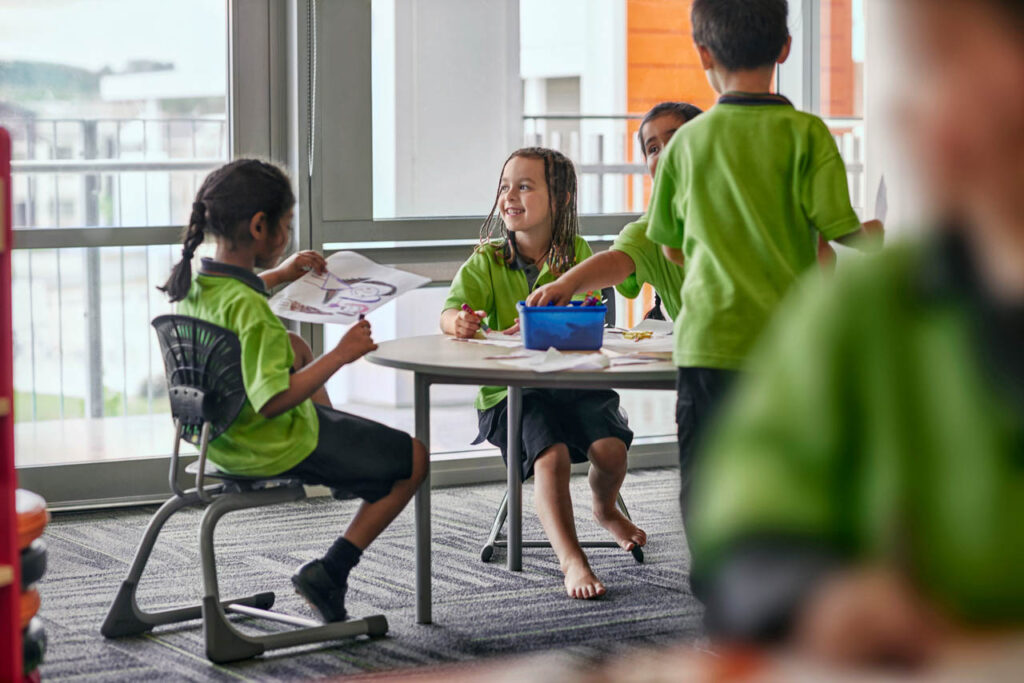
All children from 6 to 16 must attend school or home-based education, with most children starting school on their 5th birthday or within that year. The New Zealand school system has 13 ‘grades’, or school years. The first year at primary school is year 1 with a year 0 to transition from kindergarten depending which half of the year your child starts at. Children attend primary –year 1 to 6/8–, (intermediate –year 7/8), and secondary (high) –year 9 to 13– school.
As a migrant/newcomer, your child may start school at any time of the year.
The curriculum is balanced between practical and theoretical though methods vary greatly from one school to another. Technology is well established in the class as a learning tool, and sports activities are designed to make the most of our great outdoors.
Types of school in New Zealand
State or public schools (schools owned and funded by the government with usually a very small donation encouraged)
State integrated schools (schools with a special character), and
Private schools (schools that charge set fees for a term or year)
Home schooling is also possible, though not without the Ministry of Education's approval.
State schools
State integrated schools
Covering about 10% of Kiwi students, these schools have a ‘special character’ in that they may be run by a particular faith or education method (Steiner, Montessori, etc.). These schools are partly funded, though in most instances parents must pay a fee of around NZ$1,500 per year.
Private schools
Just 5% of New Zealand children attend private schools. There is a mix of co-educational and single sex schools throughout the country, with certain education providers having boarding facilities too. Because these schools are not funded, they apply a compulsory fee of around NZ$15,000 to NZ$20,000 per year.
Will I have to pay for my children's school and tuition fees?
A student who is not a New Zealand citizen is treated either as a domestic student or an international student depending on the documents they hold giving them the right to reside in New Zealand.
Your child can attend public school for free as a domestic student if they are a New Zealand resident, permanent resident or citizen, or if they hold a student visa based on your temporary work visa (Skill level 1, 2, 3 work visa holders). If your child is not eligible for a ‘domestic fee-paying student visa’, they may be eligible for an ‘international student visa‘, in which case fees apply.
What are typical school terms in New Zealand?
Term 1: Late January to early April (2 week break)
Term 2: May to early July (2 week break)
Term 3: Late July to late September (2 week break)
Term 4: Mid-October to mid-December (6 week summer break)

Tertiary Education
Tertiary education in New Zealand includes all post-secondary education, covering universities, polytechnics, private training establishments (PTEs), and Wānanga (Māori-focused tertiary institutions). It is known for being high-quality, internationally recognized, and relatively accessible.
Key Features of Tertiary Education in New Zealand
Qualifications Framework
All qualifications are aligned with the New Zealand Qualifications Framework (NZQF), which ensures consistency and quality. It ranges from:
Level 1–4: Certificates (basic to intermediate)
Level 5–6: Diplomas
Level 7: Bachelor’s degrees
Level 8: Graduate diplomas/certificates
Level 9–10: Master's and doctoral degrees
Student Support
Quality Assurance
The New Zealand Qualifications Authority (NZQA) and the Tertiary Education Commission (TEC) oversee quality and funding. Universities are also overseen by Universities New Zealand.

Job search in New Zealand